|
|
Please use this identifier to cite or link to this item:
https://repositorio.utn.edu.ec/handle/123456789/19122Full metadata record
| DC Field | Value | Language |
|---|---|---|
| dc.contributor.advisor | Michilena Calderon, Jaime Roberto | - |
| dc.contributor.author | Pantoja Pinchao, María Fernanda | - |
| dc.date.accessioned | 2026-03-05T18:05:20Z | - |
| dc.date.available | 2026-03-05T18:05:20Z | - |
| dc.date.created | 2026-02-27 | - |
| dc.date.issued | 2026-03-05 | - |
| dc.identifier.other | 04/TEL/ 093 | es_EC |
| dc.identifier.uri | https://repositorio.utn.edu.ec/handle/123456789/19122 | - |
| dc.description.abstract | El presente trabajo de titulación desarrolla un análisis de factibilidad técnica y financiera para la implementación de una red híbrida de radioenlace y fibra óptica FTTH GPON en la parroquia rural La Merced de Buenos Aires, ubicada en el cantón Urcuquí, provincia de Imbabura. El estudio se realiza debido a la limitada calidad del servicio de internet en la zona, ocasionada por factores geográficos, dispersión poblacional y los elevados costos del despliegue de infraestructura de fibra óptica. En primer lugar, se analiza la situación actual de la parroquia, considerando aspectos demográficos, geográficos y de conectividad, identificando que los servicios existentes no garantizan estabilidad ni calidad adecuada. Posteriormente, se evalúan los requerimientos técnicos para el diseño de una red híbrida que combina enlaces de radio para el transporte troncal y una red FTTH GPON para la distribución del servicio a los usuarios finales. Para validar el diseño propuesto, se realizaron simulaciones de radioenlace mediante los softwares Radio Mobile y AirLink Ubiquiti, así también simulaciones de la red FTTH en OptiSystem, obteniendo resultados favorables en cuanto a niveles de potencia y pérdidas del sistema. Asimismo, se identificó la documentación técnica y los permisos requeridos por la ARCOTEL para la operación de una red híbrida en zona rural. Finalmente, se realizó un análisis financiero considerando los costos de inversión, operación y mantenimiento, además de ingresos proyectados en un horizonte de cinco años. Los indicadores financieros obtenidos, incluyendo VAN y TIR, evidencian que el proyecto es económicamente viable y rentable. | es_EC |
| dc.language.iso | spa | es_EC |
| dc.rights | openAccess | es_EC |
| dc.rights | Atribución-NoComercial-CompartirIgual 3.0 Ecuador | * |
| dc.rights.uri | http://creativecommons.org/licenses/by-nc-sa/3.0/ec/ | * |
| dc.subject | FIBRA ÓPTICA | es_EC |
| dc.subject | RED DE TELECOMUNICACIONES | es_EC |
| dc.subject | INTERNET | es_EC |
| dc.subject | ZONA RURAL | es_EC |
| dc.title | Análisis de factibilidad para la implementación de una red hibrida de radio enlace y red GPON FTTH enfocada a la zona rural parroquia La Merced de Buenos Aires del cantón Urcuquí en la provincia de Imbabura para la empresa ProFyber SCC | es_EC |
| dc.type | bachelorThesis | es_EC |
| dc.description.degree | Ingeniería | es_EC |
| dc.contributor.deparment | Ingeniero en Telecomunicaciones | es_EC |
| dc.coverage | Urcuquí | es_EC |
| dc.identifier.mfn | 0000046677 | es_EC |
| dc.subject.en | HYBRID NETWORK | es_EC |
| dc.subject.en | FTTH GPON | es_EC |
| dc.subject.en | RADIO LINK | es_EC |
| dc.subject.en | FEASIBILITY ANALYSIS | es_EC |
| dc.subject.en | RURAL CONNECTIVITY | es_EC |
| dc.description.abstract-en | This thesis develops a technical and financial feasibility analysis for the implementation of a hybrid radio link and FTTH GPON fiber optic network in the rural parish of La Merced de Buenos Aires, located in the canton of Urcuquí, province of Imbabura. The study was conducted due to the limited quality of internet service in the area, caused by geographical factors, population dispersion, and the high costs of deploying conventional fiber optic infrastructure. First, the current situation of the parish is analyzed, considering demographic, geographic, and connectivity aspects, identifying that existing services do not guarantee stability or adequate quality. Subsequently, the technical requirements for the design of a hybrid network that combines radio links for trunk transport and an FTTH GPON network for the distribution of the service to end users are evaluated. To validate the proposed design, radio link simulations were performed using Radio Mobile and AirLink Ubiquiti software, as well as FTTH network simulations in OptiSystem, obtaining favorable results in terms of power levels and system losses. Likewise, the technical documentation and permits required by ARCOTEL for the operation of a hybrid network in rural areas were identified. Finally, a financial analysis was carried out considering investment, operation, and maintenance costs, as well as projected revenues over a five-year horizon. The financial indicators obtained, including NPV and IRR, show that the project is economically viable and profitable. | es_EC |
| Appears in Collections: | Telecomunicaciones | |
Files in This Item:
| File | Description | Size | Format | |
|---|---|---|---|---|
| 04 TEL 093 LOGO.jpeg | LOGO | 50.8 kB | JPEG | 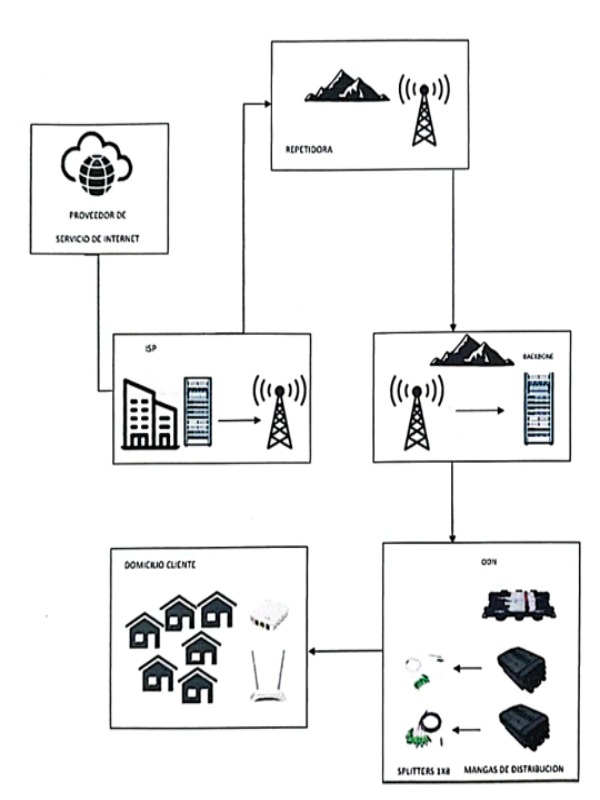 View/Open |
| 04 TEL 093 TESIS.pdf | TRABAJO DE GRADO | 5.34 MB | Adobe PDF |  View/Open |
This item is protected by original copyright |
This item is licensed under a Creative Commons License