

|
|
Por favor, use este identificador para citar o enlazar este ítem:
https://repositorio.utn.edu.ec/handle/123456789/19371Registro completo de metadatos
| Campo DC | Valor | Lengua/Idioma |
|---|---|---|
| dc.contributor.advisor | Paredes Gomez, Ronnie Andres | - |
| dc.contributor.author | Paredes Calderon, Ivan Francisco | - |
| dc.date.accessioned | 2026-03-23T15:54:58Z | - |
| dc.date.available | 2026-03-23T15:54:58Z | - |
| dc.date.created | 2026-03-19 | - |
| dc.date.issued | 2026-03-23 | - |
| dc.identifier.other | 06/FIS/076 | es_EC |
| dc.identifier.uri | https://repositorio.utn.edu.ec/handle/123456789/19371 | - |
| dc.description.abstract | La fuerza de agarre manual es un indicador confiable de la función muscular general y un predictor sólido de limitaciones funcionales futuras, cuya alteración se relaciona directamente con dificultades en el desempeño laboral y las actividades de la vida diaria. Por ello, el objetivo de este estudio fue evaluar la fuerza de agarre y el nivel de discapacidad de la extremidad superior en trabajadores de fábricas textiles de Atuntaqui. La metodología aplicada se basó en un diseño no experimental y de corte transversal con un enfoque cuantitativo de alcance descriptivo, en una población constituida por 106 trabajadores de 13 empresas locales, seleccionados mediante muestreo por conveniencia. Los instrumentos de recolección incluyeron una ficha de datos generales del paciente e instrumentos validados como el cuestionario DASH para valoración de la discapacidad y la dinamometría manual con el dinamómetro Jamar. Los resultados mostraron que la mayoría manifestó dolor leve, con predominio del sexo femenino y el puesto de tejedor; una fuerza media de 25,48 kg en la mano dominante frente a 24,05 kg en la no dominante; asimismo, el 73,6% reportó discapacidad leve. Se concluye que existe una diferencia en la fuerza de agarre de 1.43kg entre la mano dominante y no dominante, una marcada dominancia de la discapacidad leve en adultos jóvenes con más de 11 años de antigüedad, evidenciando la necesidad de implementar programas de vigilancia ergonómica y estrategias de intervención fisioterapéutica | es_EC |
| dc.language.iso | spa | es_EC |
| dc.rights | openAccess | es_EC |
| dc.rights | Atribución-NoComercial-CompartirIgual 3.0 Ecuador | * |
| dc.rights.uri | http://creativecommons.org/licenses/by-nc-sa/3.0/ec/ | * |
| dc.subject | DISCAPACIDAD | es_EC |
| dc.subject | SALUD OCUPACIONAL | es_EC |
| dc.subject | INDUSTRIA TEXTIL | es_EC |
| dc.subject | DETECCIÓN DE ENFERMEDADES | es_EC |
| dc.title | Fuerza de agarre y discapacidad de la extremidad superior, en trabajadores de fábricas textiles, Atuntaqui 2025-2026 | es_EC |
| dc.type | bachelorThesis | es_EC |
| dc.description.degree | Licenciatura | es_EC |
| dc.contributor.deparment | Licenciatura en Fisioterapia | es_EC |
| dc.coverage | Atuntaqui | es_EC |
| dc.identifier.mfn | 0000046835 | es_EC |
| dc.subject.en | GRIP STRENGTH | es_EC |
| dc.subject.en | DISABILITY | es_EC |
| dc.subject.en | DYNAMOMETRY | es_EC |
| dc.subject.en | TEXTILE INDUSTRY | es_EC |
| dc.subject.en | OCCUPATIONAL HEALTH | es_EC |
| dc.subject.en | MUSCULOSKELETAL DISORDERS | es_EC |
| dc.description.abstract-en | Manual grip strength is a reliable indicator of overall muscular function and a strong predictor of future functional limitations. Reduced grip strength is closely associated with difficulties in job performance and activities of daily living. Therefore, this study aimed to evaluate grip strength and the level of upper extremity disability among textile factory workers in Atuntaqui. The study employed a quantitative, non-experimental, cross-sectional design with a descriptive scope. The study population consisted of 106 workers from 13 local textile companies, selected through convenience sampling. Data collection instruments included a general demographic and occupational data form, the validated Disabilities of the Arm, Shoulder, and Hand (DASH) questionnaire to assess upper limb disability, and manual grip strength measurements obtained using a Jamar dynamometer. The results indicated that most participants reported mild pain, with a predominance of female workers and those employed in weaving positions. The average grip strength was 25.48 kg in the dominant hand and 24.05 kg in the non-dominant hand. Additionally, 73.6% of the participants reported mild upper extremity disability. In conclusion, a mean difference of 1.43 kg in grip strength was observed between the dominant and non-dominant hands. Mild disability was predominant among young adult workers with more than 11 years of occupational seniority. These findings underscore the need to implement ergonomic surveillance programs and targeted physiotherapy intervention strategies to prevent and manage upper extremity musculoskeletal disorders in the textile industry. | es_EC |
| Aparece en las colecciones: | Fisioterapia | |
Ficheros en este ítem:
| Fichero | Descripción | Tamaño | Formato | |
|---|---|---|---|---|
| 06 FIS 076 LOGO.jpg | LOGO | 431.1 kB | JPEG | 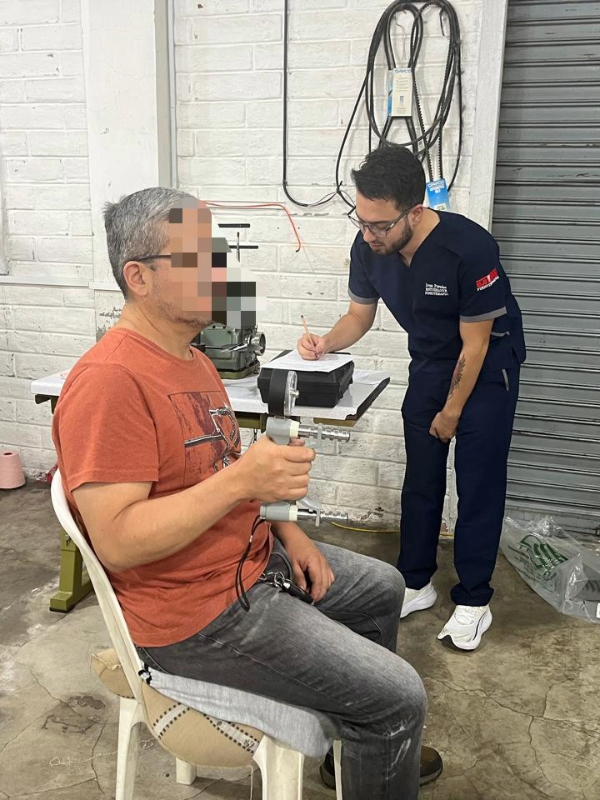 Visualizar/Abrir |
| 06 FIS 076 TESIS.pdf | TRABAJO DE GRADO | 4.48 MB | Adobe PDF |  Visualizar/Abrir |
Este ítem está protegido por copyright original |
Este ítem está sujeto a una licencia Creative Commons Licencia Creative Commons

