|
|
Please use this identifier to cite or link to this item:
https://repositorio.utn.edu.ec/handle/123456789/19161| Title: | Prototipo funcional usable para fortalecer la facilidad de uso web del proceso de registro académico del porfolio docente en la UTN. |
| metadata.dc.contributor.advisor: | Vicente Alexander, Guevara Vega |
| Authors: | Pomasqui Pantoja, Ricardo Daniel |
| metadata.dc.type: | bachelorThesis |
| Keywords: | SISTEMA DE INFORMACIÓN;PLATAFORMA DIGITAL;USUARIO DE INFORMACIÓN |
| metadata.dc.subject.en: | UX/UI;ORACLE APEX;ISO/IEC/IEEE 23026;ACADEMIC REGISTRATION;A/B TESTING;SUS SCALE |
| Issue Date: | 6-Mar-2026 |
| metadata.dc.date.created: | 4-Mar-2026 |
| Abstract: | La presente investigación tiene como propósito el desarrollo de un prototipo funcional usable orientado a fortalecer la facilidad de uso web en el proceso de registro académico del portafolio docente de la Universidad Técnica del Norte (UTN). El estudio se fundamenta en los principios de diseño UX/UI y el estándar ISO/IEC/IEEE 23026, bajo un enfoque de Diseño Centrado en el Usuario para optimizar la interacción y reducir la carga cognitiva del docente. El documento se estructura en tres capítulos fundamentales que detallan el proceso de ingeniería de software aplicado. En el Capítulo 1, se establece el marco teórico referencial, donde se profundiza en la importancia de los principios de UX/UI y el Modelo de Diseño Centrado en el Usuario (MCU). Se analizan las métricas de usabilidad y se definen las directrices de la norma ISO/IEC/IEEE 23026 como eje normativo para garantizar la calidad y eficiencia de la interfaz propuesta. El Capítulo 2 aborda el desarrollo técnico del proyecto, iniciando con el levantamiento de requerimientos y un diagnóstico cualitativo de la situación actual del portafolio docente para identificar puntos de fricción operativa. Posteriormente, se detalla la fase de idealización y el rediseño de los módulos académicos mediante la plataforma Oracle APEX, priorizando una arquitectura de información plana y el uso de componentes reactivos. En el Capítulo 3, se describe el proceso de validación del prototipo a través de la aplicación de métricas técnicas y de percepción. Para ello, se definen instrumentos como el Test A/B para contrastar la eficiencia entre la versión actual y la propuesta, la Escala de Usabilidad de Sistema (SUS) para cuantificar la facilidad de uso percibida, y encuestas de satisfacción enfocadas en la experiencia de usuario. Finalmente, se presentan las conclusiones y recomendaciones que orientan la viabilidad de la implementación del prototipo en el ecosistema digital universitario. |
| metadata.dc.description.abstract-en: | The purpose of this research is to develop a usable functional prototype to strengthen web usability in the academic registration process of the faculty portfolio at the Technical University of the North (UTN). The study is grounded in UX/UI design principles and the ISO/IEC/IEEE 23026 standard, adopting a User-Centered Design (UCD) approach to optimize interaction and reduce the teacher's cognitive load. The document is organized into three main chapters detailing the applied software engineering process. In Chapter 1, the theoretical framework is established, exploring the significance of UX/UI principles and the User-Centered Design (UCD) model. Usability metrics are analyzed, and the ISO/IEC/IEEE 23026 standard guidelines are defined as the regulatory framework to ensure the quality and efficiency of the proposed interface. Chapter 2 covers the technical development of the project, starting with requirements gathering and a qualitative diagnosis of the current state of the faculty portfolio to identify operational friction points. Subsequently, it details the idealization and redesign phase of the academic modules using the Oracle APEX platform, prioritizing a flat information architecture and the use of reactive components. In Chapter 3, the prototype validation process is described through the application of technical and perception metrics. To this end, evaluation instruments are defined, such as A/B Testing to compare efficiency between the current version and the proposal, the System Usability Scale (SUS) to quantify perceived ease of use, and satisfaction surveys focused on user experience. Finally, the conclusions and recommendations regarding the feasibility of implementing the prototype within the university's digital ecosystem are presented. |
| URI: | https://repositorio.utn.edu.ec/handle/123456789/19161 |
| metadata.dc.identifier.other: | 04/SOF/145 |
| metadata.dc.coverage: | Ibarra |
| metadata.dc.description.degree: | Ingeniería |
| metadata.dc.identifier.mfn: | 0000046704 |
| metadata.dc.contributor.deparment: | Ingeniero de software |
| Appears in Collections: | Software |
Files in This Item:
| File | Description | Size | Format | |
|---|---|---|---|---|
| 04 SOF 145 TESIS.pdf | TRABAJO DE GRADO | 9.98 MB | Adobe PDF |  View/Open |
| 04 SOF 145 LOGO.jpg | LOGO | 386.29 kB | JPEG | 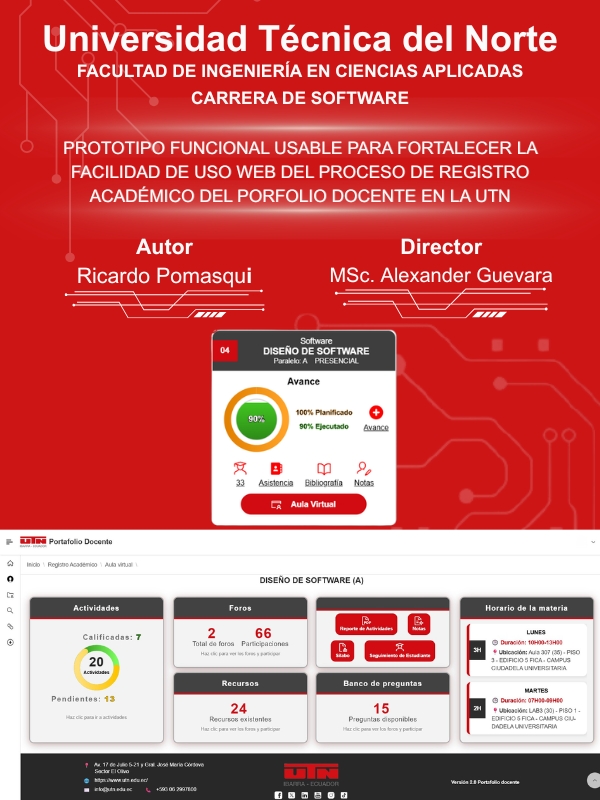 View/Open |
This item is protected by original copyright |
This item is licensed under a Creative Commons License